
From Shore to Sea: How Spearfishers of Buru Show us the Way of Marine Conservation
- July 8, 2026
by Reno Nanda Pratama
Not long ago, a recreational fishing and spearfishing advertisement flashed across my screen with alluring luxurious nuance. It carried a hefty price tag, marketed as an adrenaline-pumping adventure complete with high-definition photo and video packages tailored for social media fame.
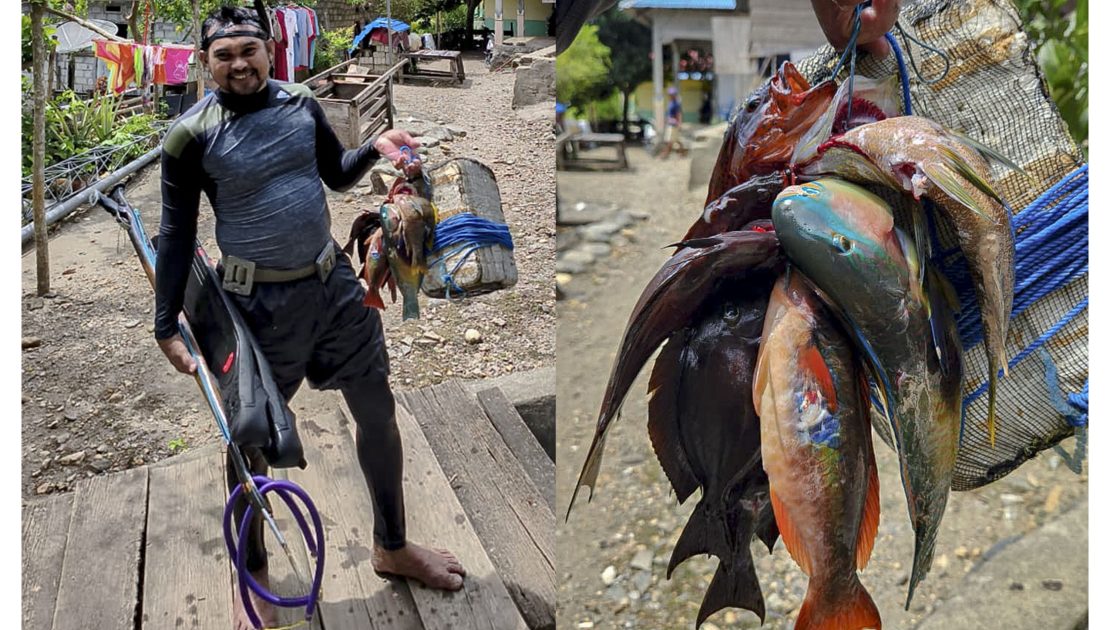
But here on Buru Island, a remote outpost in the Maluku archipelago, I found myself embedded with men who submerge themselves into that very same environment almost every single night. They do not call it a sport. They do not use state-of-the-art, imported gear, and they certainly are not chasing likes on Instagram. For them, spearfishing is a grueling, nightly harvest—the thin line separating a family’s security from financial precarity.
I came to these coastal villages of Waprea and Wailihang while representing a team of MDPI. We were conducting an initial assessment for a program aimed at strengthening community-led marine conservation. Instead of just analyzing data, I spent hours talking with Ridwan Umanailo, Randi Tukang, Juliansya Malaka, and several other local divers who spend the midnight hours suspended beneath the ocean’s surface.
From them, I learned that their craft requires far more than a steady hand and a sharp spear. It demands a profound, generational intimacy with the sea—an archive of local ecological knowledge that may hold the key to saving these fragile waters.
Hunting in the Beam of Flashlight
To survive as a traditional spearfisher, one must possess an instinctive understanding of fish behavior, shifting currents, and the limits of human lung capacity. Perhaps counterintuitively, the real work begins only after the sun goes down.
According to Juliansya and his fellow divers, darkness is their greatest ally. In the dead of night, the ocean slows down. Many fish species become lethargic, seeking shelter among the shadows.
When the sharp beam of a diver’s underwater flashlight slices through the dark, the fish often freeze, paralyzed by the glare. It gives the diver a fleeting, critical window to draw close.
To maneuver through the tight, jagged labyrinths of the coral reefs, these fishermen prefer shorter, custom-made spearguns. These compact weapons allow for agility in confined spaces and require less physical exertion when repeatedly cocking the heavy rubber bands over a grueling five-hour shift.
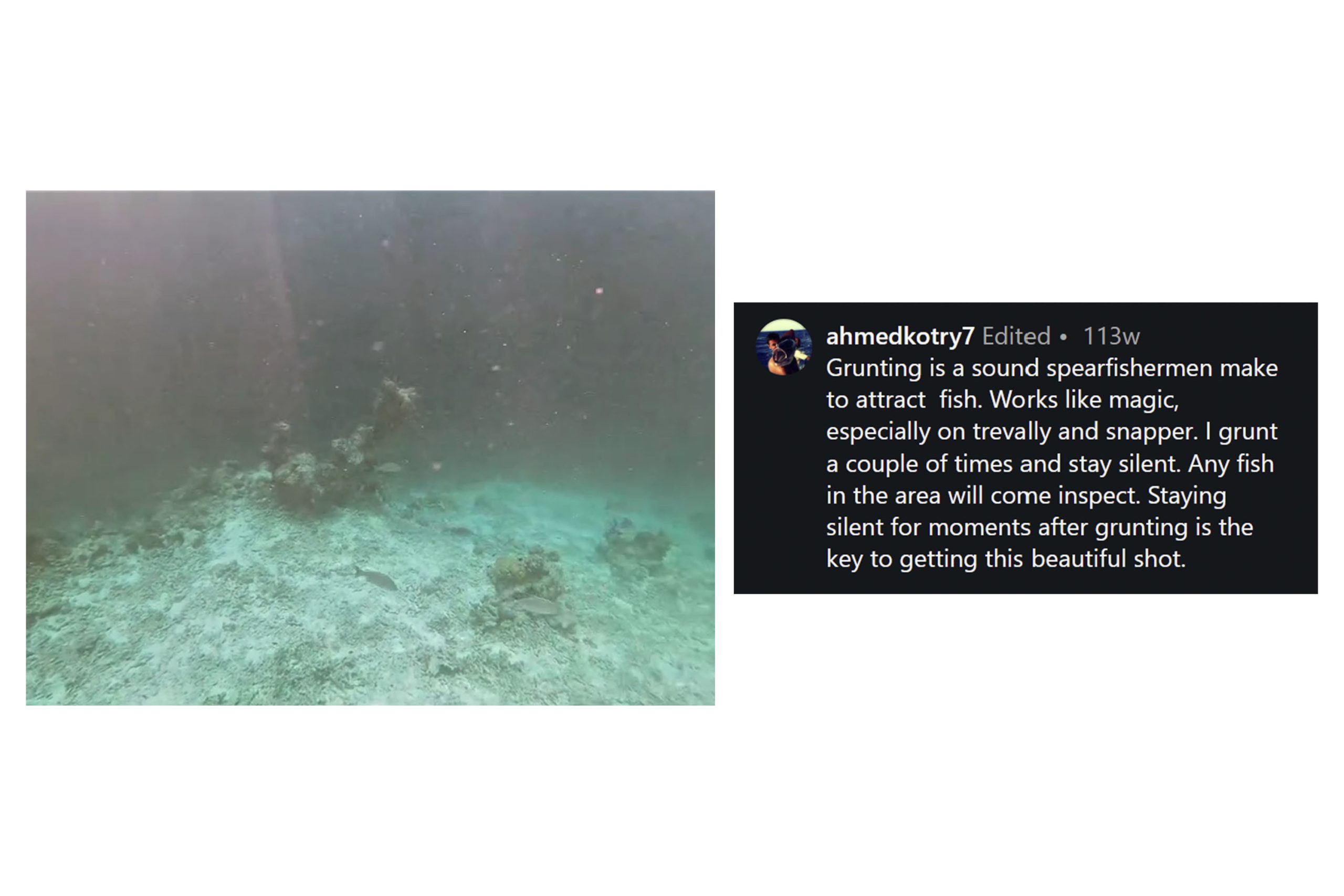
They also employ a fascinating acoustic trick to lure their prey. By compressing the air in their throats, the divers produce a distinct clicking sound under water. It is a siren song born of experience: the noise triggers the natural curiosity of certain fish, drawing them out of hiding and straight toward the tip of the spear.
 Source: Instagram user ahmedkotry7
Daytime hunting, by contrast, requires an entirely different strategy. Under the harsh sun, visibility cuts both ways; the fish can see the silhouette of a descending diver from a distance and are hyper-alert. For these daytime excursions, the fishermen switch to longer spearguns designed for maximum range and velocity.
This stark difference in conditions has created a culture of specialization among the village men. Some hunt exclusively for fish in the open water column, while others specialize in tracking lobsters deep within the reef’s recesses.
“If you’re looking for fish, your eyes must constantly scan the open water,” Randi Tukang explained to me, his face weathered by salt and sun. “If you’re after lobster, your focus has to be entirely on the dark holes in the coral. You cannot effectively do both at the same time.”
This specialization directly dictates the economics of the village. The standard, mid-sized table fish are usually sold directly to fellow villagers for daily consumption. However, high-value catches (such as red snapper, grouper, trevally, and Spanish mackerel) are packed on ice and shipped to the market town of Namlea, where they command premium prices.
On Buru Island, the success of a single night under the waves determines whether a family eats well the following day.
Resilience Forged by the Sea
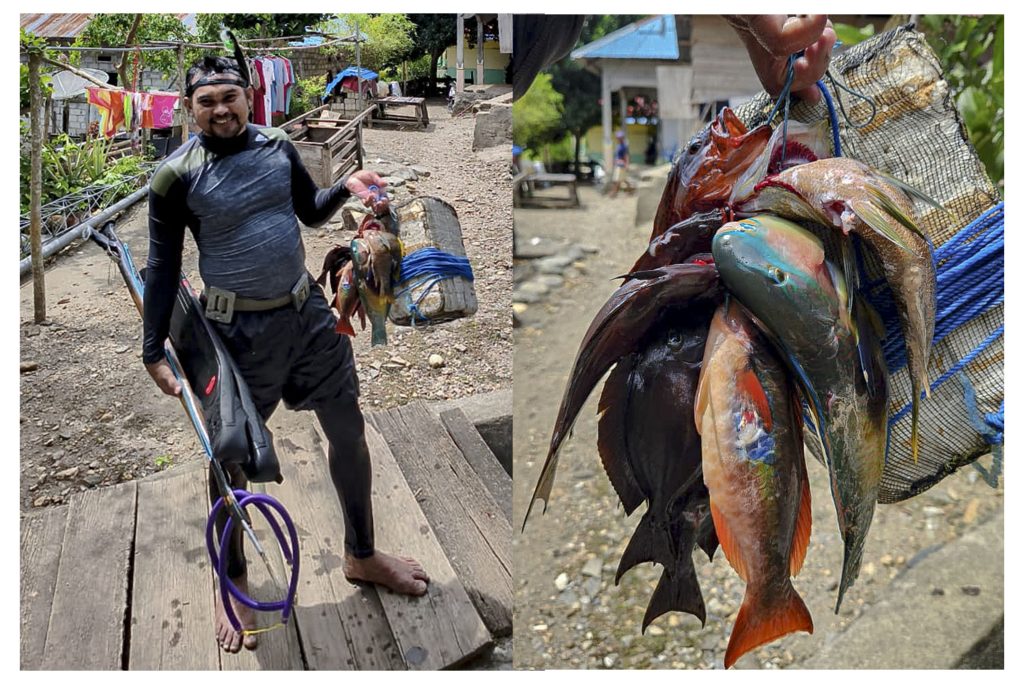
The spearfishermen of Buru Island are entirely self-taught. None have ever taken a formal freediving course, nor do they hold plastic scuba certifications. Instead, their lung capacity and diving reflexes have been forged over a lifetime of trial and error.
Without the aid of oxygen tanks, some of these men routinely dive to depths of dozens of meters on a single breath, stalking their prey in pitch blackness.
Randi Tukang noted that a typical night involves up to five hours in the water, usually split into two grueling sessions. His target is modest: just enough fish to keep his family afloat.
His equipment has evolved along a similar trajectory of necessity. Years ago, the divers relied on rudimentary, home-made wooden spearguns and cheap plastic headlamps that they meticulously waterproofed with melted rubber and tape.
“I can’t tell you how many flashlights I lost because they imploded under the water pressure,” Juliansya recalled, breaking into a wide laugh.
Today, most of the village fishermen have upgraded to commercial gear: neoprene wetsuits, proper masks, snorkels, long fins, and specialized dive lights. Investing in a full setup can cost upward of 10 million rupiah (roughly $650 USD)—a staggering sum for a small-scale fisherman, representing a massive leap of faith in their own ability to harvest the sea.
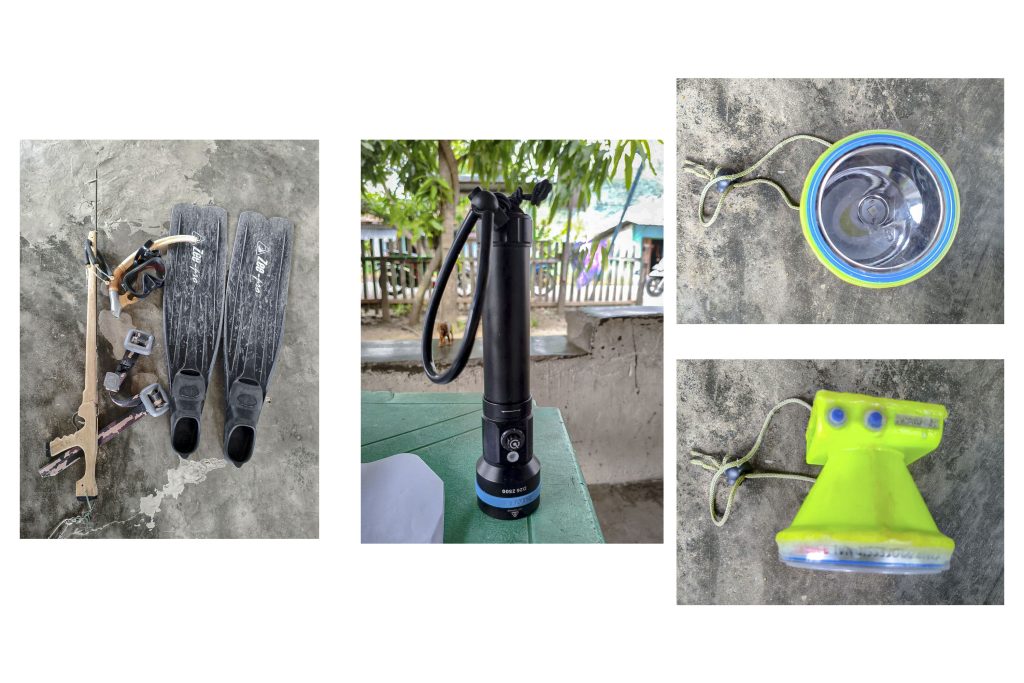
Randi’s fishing equipments, complete with a short-barrel speargun to fish at night.
The Risks Beneath the Dark
While the surface of the Banda Sea can look like glass at night, the world beneath it is fraught with many risks.
The most dangerous threat is the sheer physical toll of barotrauma. Ridwan Umanailo once lost hearing in one of his ears for several months. He once failed to equalize properly during a rapid descent into the deep.
Yet, true to the resilient nature of coastal communities, this injury has been absorbed into local folklore.
“The old timers say that once your eardrum bursts and heals, diving actually becomes easier,” Ridwan said with a wry smile. Behind the joke, however, lies an honest acceptance that the business can cost bodily harm.
Then there are the predators. Sharks are a constant presence, drawn like ghosts by the low-frequency vibrations of a struggling fish. Worse still, the coastal waters of Buru Island are known habitats for saltwater crocodiles.
Before sliding into the black water at night, the men perform a vital ritual. They sweep the surface with their high-powered flashlights, searching the distance for crimson glints of a crocodile’s eyes. If a pair of eyes reflects back, they pull up anchor and move down the coast.
Decades of sharing the water with sharks have also taught them practical survival tactics. The fishermen never attach their catch directly to their bodies or waistbelts. Instead, the speared fish are placed into a floating cooler towed behind the swimmer. If a shark decides to claim the catch, it takes the cooler, not the man.
Read also: Four Ways to Maximize the ‘Merah Putih’ Fishing Village Program
When Experience Transforms Ecological Wisdom
The more time I spent listening to these men, the more I realized that their relationship with the ocean transcends mere extraction.
Spending thousands of hours suspended over the reefs has turned them into acute observers of marine ecology. They know which coral heads are thriving, which sectors are degrading, and exactly how the lunar cycles govern the migrations of fish.
Conserving Reefs from Below
Ridwan emphasized that avoiding physical damage to the reef is a matter of self-preservation. Coral reefs, he notes, can take an eternity to grow back once broken.
This protective instinct manifests in a quiet, daily stewardship. Many of the spearfishers make a habit of collecting marine debris at sea. Other than fish, they hunt for discarded clothing, fragments of ropes, and ghost nets tangled in the reef.
What began as a purely pragmatic habit has evolved into an ecological understanding. The fishers noticed that when synthetic debris smothers a coral head, the coral suffocates and will drive the fish away. By clearing the trash, they are actively maintaining their own underwater gardens.
Selektivitas Tangkapan dan Prinsip Keberlanjutan
Unlike commercial net trawlers that indiscriminately scoop up entire ecosystems, spearfishing is inherently selective. Every single catch represents a conscious decision made in a fraction of a second beneath the surface.
“If a fish is too small, we leave it alone. There is no meat on it anyway,” Ridwan said simply.
The same unwritten rule applies to lobsters. If a diver flips over a rock and finds a female lobster carrying a mass of eggs beneath her tail, they leave her undisturbed to protect the future population.
These sustainable practices did not come from Western NGOs or government seminars. They were born out of a long-term understanding of bitter realization. That if they destroy the ecosystem today, their children will starve tomorrow.
This deep-seated conservation ethic is why the traditional divers are the loudest opponents of destructive fishing practices. Cyanide poisoning and dynamite blasting perpetrated by outsiders decrease.
Locals as Leading Conservation Partners
The government-designated Marine Protected Area (KKPD) surrounding Buru Island encompasses critical coastal zones rich in biodiversity, protecting everything from coral sanctuaries to nesting grounds for sea turtles and the rare Maleo bird.
But for the people of Waprea and Wailihang, this protected area is not a collection of coordinates on a bureaucratic map. It is their living room.
The Local Ecological Knowledge (LEK) held by these fishermen is the most valuable asset groups like MDPI can leverage. Their data is real-time, lived experience. They know where the fish aggregate, which zones are under pressure, and how the currents are shifting as the climate changes.
The lesson from Buru Island is clear: marine conservation cannot be successfully implemented via a top-down, authoritarian approach. It requires partnering with the people whose survival is inextricably linked to the health of the sea.
On my final night in Waprea, I stood on the shore and watched several faint pinpricks of light. As they danced slowly across the pitch-black horizon, the fragility reeks out. The view told before my eyes how almost insignificant we are against the vastness of the ocean.
But beneath those lights were men who know the sea as an ancestral home, a workplace, and a legacy. True conservation does not begin in an air-conditioned boardroom or within the pages of a policy brief. It begins in the water, carried in the minds of those who live by the spear, watch the ocean change, and have the greatest stake in ensuring it remains alive for generations to come.
The reef ecosystem in Waprea waters.