
Less Fish, Less on the Dining Table: The Story of Fisher Families Refusing to Sink
- November 20, 2025
by Reno Nanda Pratama
Every time her husband’s small boat disappears behind the horizon, Nurfita Thalib watches until it is swallowed by the sea line. She never knows if the vessel will return laden with fish, or if it will carry back nothing but a crew exhausted from fighting the waves. Yet, one constant remains: on land, she must ready her bucket, set up her roadside table, and summon the will to survive.
————————–
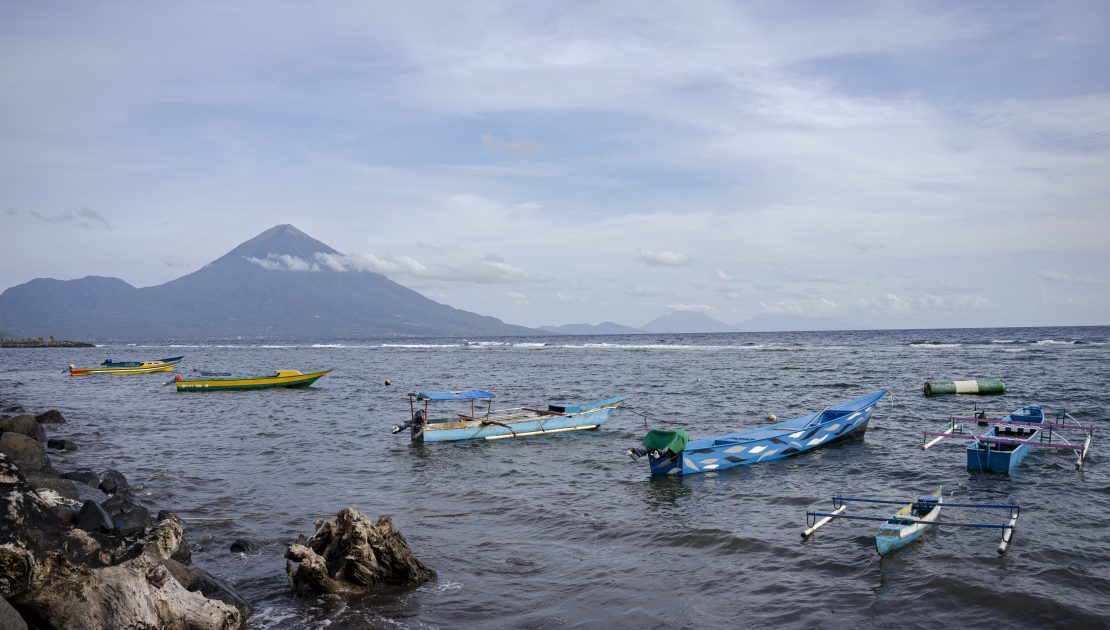
Rain poured in Jambula on a recent afternoon. The sky was gloomy, but the ocean’s call was relentless. At the small jetty, boats were prepping for launch.
“If we just stay home, who will fill the children’s stomachs?” Nurfita told me, arranging buckets to receive her husband’s catch.
I arrived in this village initially to collect profile data on the fishing communities we assist. But that intention quickly mingled with a different kind of curiosity: how do fisher families actually survive when the ocean turns stingy and fish prices go into freefall?
Years ago, tuna was a symbol of hope here. It meant big fish, high prices, and the promise of lucrative export markets. Around 2015, the fishers of Jambula shifted their focus from smaller catches like skipjack and mackerel to yellowfin tuna. For a while, life improved. Incomes rose, homes were renovated, and children were sent to school without their parents having to beg loans from loan sharks.
But that golden era was short-lived.
Today, tuna are increasingly elusive. When caught, the payout is no longer worth the effort. Where a kilogram once fetched over Rp 40,000 (US$2.60), prices now struggle to hit Rp 30,000. The cost of fuel, ice, and supplies often outweighs the earnings from the catch. Many have been forced to revert to the old ways—catching smaller, lower-value fish—just to keep the kitchen smoking.
Ripples from a Distant World
The price collapse isn’t just a matter of scarcity. The waters of Jambula are being churned by forces invisible to the local fishers: global trade policy.
Recently, the United States—a primary destination for Indonesian tuna—hiked import tariffs by up to 32 per cent. For a small-scale fisher here, such figures sound abstract. But the impact is visceral: export demand drops, collectors squeeze purchasing prices, and the entire coastal economy shudders.
It is a cruel irony of the modern maritime economy: a policy decision made in a government building thousands of kilometres away determines whether a child in Ternate eats fish for dinner.
Women on the Frontlines
As the men about by the uncertainty of the sea, I observed that it is their wives who stand firm on solid ground.
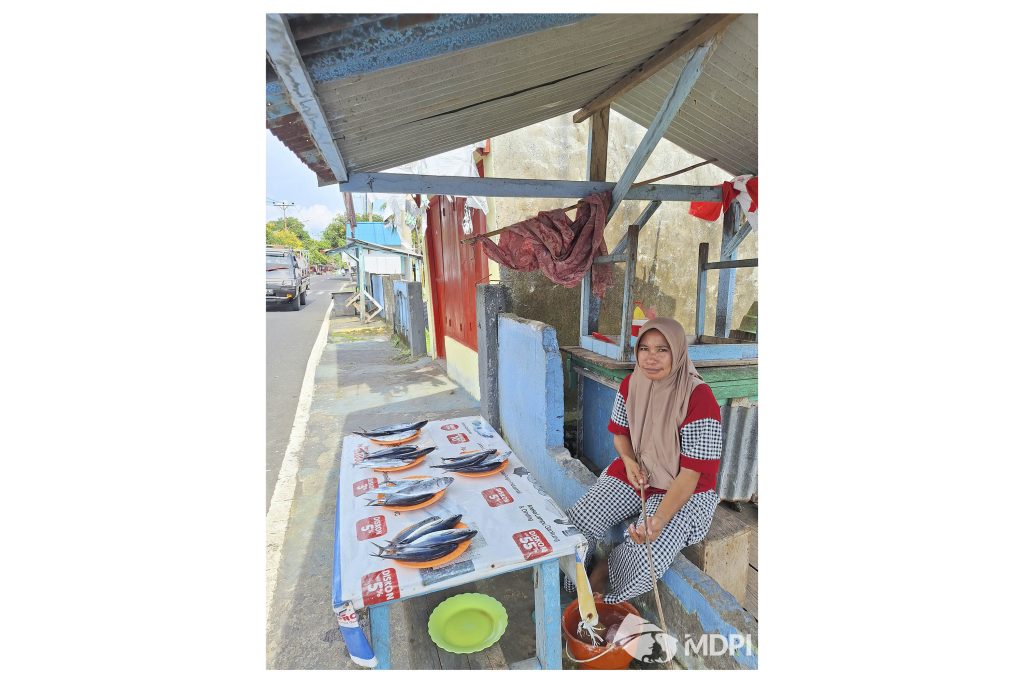
Along the provincial road that cuts through Jambula, the scene is identical every afternoon: wooden tables, buckets of fresh catch, and women shouting out prices to passing motorists. They gave up relying on suppliers, middlemen.
Nurfita is one of them. She is a member of the Makufato processing and marketing group (Poklahsar), assisted by MDPI.
“If we go through a local supplier, one barrel [40 litres] pays about Rp 400,000 (around USD 24). The highest we ever saw was Rp 1.8 million (USD 108). But if we sell it ourselves, we can make much more than that,” Nurfita told me from her terrace, arranging fresh skipjack tuna.
From her earnings, Nurfita sets aside USD 30 to deposit in the Bubula Ma Cahaya fisher’s cooperative. These small savings represent big dreams: she wants her son to be a soldier and her daughter a medical doctor.
“If the wife keeps her spirit up, the husband stays spirited too,” she said with a soft laugh.
Survival Mode
Nurfita is not an outlier. Across Jambula, I saw many families refusing to sink. They have pivoted to smaller fish, strategized their sales, formed women’s collectives, and created micro-economic systems they can control.
The income is modest, but it is enough to survive—and crucially, it breaks their total dependence on exploitative collectors.
Locals still celebrate good fishing season. I watched them grill fish on the beach, eating together to keep morale high. In a time of volatility, this togetherness is their anchor. They know the ocean is no longer generous, but they also know they cannot leave it behind.
A Fairer Sea
The story of Jambula is more than a fluctuation in market prices. It is a testament to how global decisions alter the rhythm of life in remote villages, and how women step up to preserve the family unit when economic structures fail them.
The state must step in—protecting price floors, opening fairer market access, and strengthening the bargaining power of small-scale fishers. The industry, too, must allow for distribution channels that source directly from communities.
Ultimately, a fair ocean is not just about an abundance of fish; it is about a dignified life for those who stake their fate on the waves.